Friday, November 20, 2015

Fighting Nazis and racism

In my last post, I read a magazine and a newspaper article. Both were related to heroin. After reading the New York Times story, I brought up the issue that black families weren't empowered to stand up and change the conversation around addiction. So, I chose a handful of quotes from Ta-Nehisi Coates's "The Case for Reparations" for a follow-up post to further discuss that issue. 

   "Clyde Ross grew. He was drafted into the Army. The draft officials offered him an exemption if he stayed home and worked. He preferred to take his chances with war. He was stationed in California. He found that he could go into stores without being bothered. He could walk the streets without being harassed. He could go into a restaurant and receive service.    Ross was shipped off to Guam. He fought in World War II to save the world from tyranny. But when he returned to Clarksdale, he found that tyranny had followed him home."

So many things about this bother me. Clyde Ross chose war over staying home to work. Ross would rather risk death than the oppression he faced working at home in Mississippi. Life was so bad, people would rather die for their country than live in it. I basically said the same thing thrice because it is such a problem. I like to believe every person has good in himself or herself, yet this proves me wrong. Ross's home environment seemed more toxic to him, so he opted to take his chances with the Nazis and their Axis Power buddies.

Ross knew life only in his home state. In California where he was stationed, he felt equal. Restaurants waited on him. Nobody expected him to move to the side or tip his hat when he walked past on a sidewalk. He was accepted. He fought "to save the world from tyranny" and returned home where it followed him. Americans have great pride in their country and the people who fight for it. Unless those people are black. Ross may have saved the world from tyranny, but he couldn't save himself. Those perpetrators of racism couldn't see the red, white and blue in him–only black.


"He came to Chicago in 1947 and took a job as a taster at Campbell’s Soup."
In a story of hardship and racism, I loved this little detail. Ross didn't just move north; he found a job as a taster of soup. 

"The men who peddled contracts in North Lawndale would sell homes at inflated prices and then evict families who could not pay—taking their down payment and their monthly installments as profit. Then they’d bring in another black family, rinse, and repeat."
Coates finds the perfect metaphor for how men sell homes on contract and how inhuman the process was. "Rinse and repeat." If the inflated prices or taking of all the money from families didn't strike a chord, adding this definitely did. I can picture the white men ushering in new families only to turn around and shoo them away, all the while keeping the money.

"Black people were viewed as a contagion."
I think Coates encapsulates the centuries of struggle here. In seven words, Coates summarized all the crap black people have gone through in their quest to be treated equally. But when will it end?

"A country curious about how reparations might actually work has an easy solution in Conyers’s bill, now called HR 40, the Commission to Study Reparation Proposals for African Americans Act. We would support this bill, submit the question to study, and then assess the possible solutions. But we are not interested.“It’s because it’s black folks making the claim,” Nkechi Taifa, who helped found N’COBRA, says. “People who talk about reparations are considered left lunatics. But all we are talking about is studying [reparations]. As John Conyers has said, we study everything. We study the water, the air. We can’t even study the issue? This bill does not authorize one red cent to anyone.”"

Lengthy excerpt, but an important one. A proposed STUDY of reparations wasn't accepted. Just a study. HR 40 merely suggests a study into reparations and possible solutions. Nkechi Taifa said it's because of who is making the claim: blacks. It's completely obvious and heartbreaking. Then to add insult to injury, John Conyers makes a great point at the end. The bill doesn't offer any money, and people study everything else under the sun. Why not reparation? Scientists study things like migration. If someone can study the movement of people, why can't someone else study the treatment of people and how to make amends for that treatment?
" At the end of World War I, black veterans returning to their homes were assaulted for daring to wear the American uniform. "

This comes back to Ross returning home to tyranny after World War II. I guess it's not surprising that about 30 years before he returned from war, others were attacked for wearing their uniform. These people were probably proudly wearing their uniforms and were trying to show how similar they are to the whites. Evidently you could be an American soldier only if you were white.

Not much changed from the first to the second war. And it was years until something did.

Friday, November 13, 2015

A variety of styles aids my writing

After hours of searching, I grew discouraged. I didn't think it would be so hard to find a long magazine story related to heroin and addiction. Lucky for me, I found one from a magazine and another from a newspaper. Bethesda Magazine, a publication I wasn't aware of until this week, and the New York Times published articles related to heroin. Bethesda featured moms who lost children to overdose while the Times focused on how white families affected by addiction are changing the conversation. It couldn't hurt to read two different styles related to the same topic.
I started with the Times article "In Heroin Crisis, White Families Seek Gentler War on Drugs" for the sources. Some are out of my reach, like the director of the White House Office of National Drug Control Policy. Others like Eric Adams, the former narcotics detective, are more within my grasp.
I thought there was a slight disconnect between the article and the headline. While it is mentioned that white addicts now experience compassion when years prior black addicts were jailed, I feel the emphasis is on lack of treatment centers and how to combat that. Kimberlé Williams Crenshaw mentions how treating blacks with such compassion back then could have prevented "the devastating impact of mass incarceration." I see a story in that. Why didn't black families feel empowered enough to challenge the policy around drug use? It bothers me that addiction had to invade powerful white families before change happened.

Because the Times article is a newspaper story, it's a dryer read. But that's good in my case. As I read through, I was making mental notes where an anecdote, scene or more detail would transform it into a magazine story. Then I switched to the regional magazine story.

Bethesda Magazine's "A Mother's Heartbreak: Heroin's Toll in Montgomery County" uses the faces of about five mothers and their children to demonstrate the rise of the heroin problem in one county. What seems like a daunting task to me became a lovely magazine story. The mothers meet as a support group. Some are connected through their now-deceased children. Using five random moms who each lost a kid to addiction wouldn't be as effective; the story wouldn't flow well.


The writer, Cindy Rich, uses scenes that have an emotional impact. Rich recreates the 911 phone call in which a mom is desperately trying to keep her son alive while the paramedics rush to the house. In another, one mom asks another how she's doing. She doesn't know why she bothers asking when she knows the answer. I hope I can recreate some powerful scenes when I write my long story. My focus going forward in my reporting is detail. Detail to hold the story upright and leave readers feeling something.

Friday, October 30, 2015

Green Mountain heroin

Vermont governor Peter Shumlin sparked the nationwide shift toward treating addiction like a health issue rather than a criminal one. Rehabilitation clinics have long waiting lists that often lead to more using while the addict waits. Rolling Stones focused on one woman's story, with others as supporting evidence, to demonstrate a lack of rehabilitation resources in Vermont.

The long piece by David Amsden relates to the story I am currently reporting on. In a way, my story on the financial assistance at one facility in New York State is a funneled version of Amsden's.

While Amsden put together a good article, I thought he overused the colon. I feel it is punctuation best reserved for special occasions, like to emphasize a fact or introduce a long quote. Some instances it came off as unnecessary. For example, Amsden paraphrases Bob Bick with a colon. "He knows how he can sound: frustrated, even overzealous." I think recasting the sentence to include those sentiments, or leaving each as its own sentence could work better.

I was first sucked into the story with the anecdotal lede. Readers learn about Eve Rivait, the small-town girl who works in the stables. Eve seems like she could be the perfect country girl. But then Amsden gets into how she fell into heroin and how it's not so idyllic in Vermont. The lede gives the story a face; it's not simply telling how there is a lack of resources but showing with a face to represent the problem. My story features a person who benefited from the financial aid of his rehab clinic, a story that would be far more boring if I simply stated the process and benefits of such a program.

Through the course of my reading, I reread sentences multiple times before fully understanding. While I was in an environment with distractions, I think this would be taken into consideration while writing the piece. I would assume readers might have the print copy and read while on noisy public transportation. The problem, I think, is the complexity of some sentences. It seemed information was included for the sake of including it. And I know that's not the case, but often information was packed into a sentence so that I couldn't understand on first read.

I appreciate the extent of Amsden's reporting, yet longer pieces often confuse me. Am I the only one? Not to say long pieces aren't good, because they can be very powerful, but it's the gap between introducing the main character and returning to him or her that throws me off. In this case, I managed to find my way back to Eve but other writers in the past have lost me.

This isn't a jab at Amsden; I just don't enjoy long pieces as much as I feel I should. I don't believe I have a short attention span. Because long articles feature extensive research, lots of information in the form of stats and quotes clutter my brain. So when the writer introduces John Doe, then veers off into facts, figures and sources before returning to Doe, I can't keep it all straight. Secondary characters/sources prove to be even more elusive when referencing them later in the article.

Despite any struggles I had in reading Amsden's article, I enjoyed how he used scenes. A personal favorite includes officer Merrigan's comment about the trio of houses where five major dealers were busted. I can visualize the run-down street and Merrigan looking out the window, saying how those major dealers are probably replaced by now. It's a little eerie.

The last scene with a pregnant Eve completes the story. Clearly well on her way to recovery, she's overcome with withdrawal symptoms. The guy at the gas station notices her and then emphasizes the article's point further by offering something he claims can help her. If the previous paragraphs chock full of hard fact and faces didn't get you, the kicker definitely did.

Friday, October 16, 2015

Beer and... cheese?

Beer in a cheese magazine. What?

At first, it sounded unnatural; beer goes with pizza, and wine goes with cheese. That's how food works. But a conversation between a lover of craft beer from Cheese Connoisseur magazine and wine expert Ron Kapon prove otherwise.

The article "Beer lovers arise!" explores the growing craft beer trend as it relates to cheese and wine. Positioned second to last in the magazine, the article is almost an abrupt turn for readers. Previous lengthier stories cover a toddler's cheese journey, a cheese master and a dairy farm in Vermont. Obviously the magazine sticks to its title. So when I stumbled upon a beer article, I was intrigued. I learned about craft beer from a wine expert. I learned that you can pair cheese with beer, and the flavors will either complement or contrast with one another. Who knew?

Apparently someone at Cheese Connoisseur magazine. The mid-length article is a simple Q&A. Most of the questions are open-ended. Kapon is asked who is buying the beer, which is followed by "is it just me or is it happening around the country?" The second question makes Kapon's answer specific to the United States where the craft brew trend is happening. Other than that, the questions include words like how, what and when, which lead to a lengthy, more informed response. The closed second question is necessary in this context because the magazine covers cheese from all over the world. So while the craft beer trend is here, consumers can pair with international cheese if they choose. 

The photos were provided by Brooklyn Brewery, who assisted in the article's preparation. Whoever took the photos is awesome. The story's headline is placed over a photo of barrels. It is strong compositionally; the angle is interesting, and the barrels are in focus. The second photo of barrels is my favorite. The photographer gives the illusion of spying on what looks like a tour of the brewery. The action of the photo is blurred as the two barrels framing the shot on either side are in focus. It combines fine art and photojournalism just as the article combines beer and cheese: pleasantly and in good taste.

Wednesday, September 23, 2015

Short and sweet

"Real Veggies Have Curves" catches readers' attention with the colorful photo of so-called ugly vegetables and the unusual headline. The article is focused on initiatives that limit food waste by using the less-than-pretty produce.

Writer Debbie Koenig's lede uses an easily understood comparison to explain the problem. The second sentence captures the theme: Perfectly good produce is wasted due to its appearance.

The products above would be deemed unsightly. To the right, the veggies are more appetizing. Both images feature usable produce. Koenig brings in a statistic ("...an estimated 30-40 percent of produce grown worldwide is tossed for strictly cosmetic reasons.") to illustrate the problem. Following the stat is a solution statement (selling produce at discounted prices), which is further supported with examples. Three initiatives combatting the waste problem are listed with brief descriptions. Each plan summary contains a plethora of facts.

The article, which I'm estimating to be 250 words, is a small list article on programs combatting produce wasted for cosmetic reasons. Nearly every sentence presents a fact. Koenig did the reporting that produced enough information for the quick, to-the-point roundup and sidebar explaining how to put ugly produce to use. While it's not clear how much extra info didn't make the article, it's clear the writer followed the 40-40-20 rule. 

I picked Koenig's article for inspiration for a short article I'm working on. I like the structure. The topic is relevant in a society obsessed with farm-to-table food. Since it ran in the September/October issue, the article is also timely; a lot of vegetables are harvested during the fall. I enjoyed how the sidebar shares tips in quick little sentences and how even the sidebar has a lede. A shocking fact shifts from how much food is wasted to how the reader can help reduce that number. The tips leave me wanting more for other food, so the link to a Web page is perfectly placed. I wish the site gave more tips than what was printed. I would also like to know of other initiatives actively reducing food waste. Debbie Koenig produced an article that will help me write my own short list article.

Monday, August 31, 2015

Secrets are no fun


Sarah Stillman's exploration of the dangers of using young offenders as confidential informants is far more detailed than any Buzzfeed or Press Republican story. 

Writing for The New Yorker allows Stillman to delve into various incidents to bring forth the issue at hand. Stories written for Buzzfeed or local newspapers are intended to get to the point about one single incident and nothing more. If a Plattsburgh teenager met the same fate as Rachel Hoffman, the main victim in Stillman’s article, or LeBron Gaither, an article in the Press Republican would quickly detail who, what, where, when, how and why with a few police and family quotes thrown in. The story shows one case. There is no comparison to other victims; newspaper stories aren’t designed that way. 

Magazine writing allows writers to effectively demonstrate a problem. Stillman does it by weaving the story of Hoffman with accounts of other confidential informant stings gone wrong. With each case, Stillman further establishes the theme.

Stillman’s use of “I” is rare and advances the story. “I” is not allowed in newspaper writing. Writers cannot put themselves in the story. However, magazines allow this personal touch if the narrative warrants it.
“I heard some version of Taylor’s statement dozens of times in the course of more than seventy interviews with people whose lives have been shaped by America’s growing reliance on young drug informants—narcotics officers, prosecutors, defense attorneys, and the friends and families of murdered C.I.s, as well as some former informants.”
To me, “I” provides credibility here. Stillman lists the varying people she has interviewed for the story. As a reader, it’s obvious Stillman has gone beyond basic reporting for a rich and emotional story.

Throughout the article, a large, single bold-faced letter crops up at the beginning of a paragraph. It visually signals a change is coming. In some instances, Stillman switches to a new victim and case. In others, Stillman remains with the previous victim but takes a different direction in the case. The contrast stands out and is easily understood.

During my initial read, I got confused. While the weaving in of other victims helps establish the theme, it also throws me off when Stillman revisits various cases. I found myself wondering, “Wait, who is that again?” But the confusion also hammered in the message: the use of confidential informants is so risky and unregulated that I can’t keep track of all the examples given.


The kicker kicked me right in the feelings. Slow clap for Stillman because that was heavy. You read about the different incidents and return to the main one with an emotional narrative of the father. The kicker would not work without the emotional detail, which wouldn’t have come out had Stillman not put in the time.

Thursday, December 4, 2014

Stop hating my boys

The most irritating responses to declaring myself a Cowboys fan include "Why?" and "I hate the Cowboys." Those hating on my boys are either fans of a rival team or despise them for being America's team. That's just how I perceive it. Or maybe the feelings are a result of the Cowboys being the most valuable NFL team, with an approximate value of $3.2 billion to the NFL average of $1.43 billion, while also missing the playoffs seven of the last ten seasons. I can understand it's frustrating for a struggling team to be so popular, but what is a team without loyal fans and sponsors?

The Dallas Cowboys have cultivated a powerful and obviously valuable brand. AT&T Stadium features a retractable roof and former Guinness record-holding video board, which measures 180 feet wide by 50 feet high. Everything is indeed bigger in Texas. Expected to open in 2016 is The Star, a 91-acre development that will include training facilities, office space, a hotel and retail development. Without the value of the Cowboys brand, a record-breaking stadium and construction of new headquarters wouldn't exist. The Cowboys name evokes pride and unity, leading to funds for new, shiny things.

Tony Romo, you silly little quarterback. Romo developed a bad reputation for choking in the fourth quarter by throwing interceptions that hand the game over to the other team. However, the guy actually has a higher passer rating than any other NFL quarterback in the fourth quarter since 2006. Romo's first two NFL passes came against the Texans on October 15, 2006. First, he completed a 33-yard pass to Sam Hurd. His next throw was a two-yard touchdown pass to Terrell Owens. Not bad for signing as an undrafted rookie free agent in 2003.

While I think it's unfair Romo is haunted by a bad rep, it has proven to be a blessing in disguise. When Romo is clutch in the fourth quarter, most of the football world is in awe. Those not respecting his game irritate me; you have to give credit where it's due. I don't care if you like him, but you can't deny the talent. What's more, I still hear ignorant people referring to him as Tony "Homo." Real mature. I should move on before I get lost in a rant. Tony Romo is magnificent in the fourth quarter, leading more than 20 game-winning drives. The stats speak for themselves. MOVING ON.

Dan Bailey for president! Or at least team MVP. When the Cowboys struggle, Mr. President swoops in to save the day with a superhuman field goal from 50 plus yards. Bailey boasts a career field goal percentage of 90. His season-long field goal increases each year, from 51 yards in 2011 to 56 yards this season. Bailey's kickoff averages just under 64 yards, with nearly half of his 311 kickoffs being touchbacks. Unlike Romo, Bailey is well-known for being dominant in his position. Bailey's kicking statistics tell a story nearly all football fans know. What interests me are his defensive stats. In 60 games played through four seasons, Dan Bailey made seven tackles, with two coming this season. I'm sure each were ugly as kickers aren't trained to bring down opponents returning the kick, but he did it nonetheless. Sadly, I couldn't find video evidence of his most recent tackle. Maybe I didn't try hard enough. Maybe it's buried deep in the plethora of "Dan Bailey kicks the football" videos. Regardless, it's time Dan Bailey be treated like Matt Prater was last season. It's certainly possible for Bailey to kick a 60-yard field goal, like Mr. Prater. Though in Bailey's case, it'll come with far more pressure behind it. Prater had a stellar Broncos team in front of him. It seems the Cowboys are finally finding some chemistry and rhythm. Previously, Bailey was by far the best player on the team most days. I wonder if his back ever hurt from carrying the team. He's probably heard that one before, though.

You shouldn't hate the Cowboys just because they're worth a crap load of money. The team is valuable because of fan loyalty. Every elite team will hit a low point. Dallas has and continues to persevere through it. Besides, we experience the lows so that we may appreciate the highs. And my dear boys seem to be on the verge of an upswing.

Wednesday, November 26, 2014

Hockey bloopers?

I stumbled upon what might be the most delightful segment of the NHL's website, which also backs up my opinion that hockey players are more fun. The "Lighter Side!" highlights the silliest moments of the season thus far. If silliness makes you giggle like me, you'll love the handful I've selected. Cue the foolishness!

Nail Yakupov's stick vs. Ryan Ellis's skate

First up is the classic hockey gaffe. A player never intends for it to happen, but the pesky hole between the boot and blade of a hockey skate attracts sticks like you wouldn't believe. The victims of this particular incident are Nail Yakupov of the Edmonton Oilers, inventor of the celly "Yakupoving", and the skate of Nashville Predators defenseman Ryan Ellis. The evil skate hole has claimed other victims, yet none can match the hilarity of Yakupov and Ellis.


Either Yakupov didn't know his stick was caught up, or he thought it could easily be dislodged. It's all the same to me. Usually the player with a stick in his skate gets tripped up. What causes me to laugh out loud is the fact that Yakupov yanks on his stick, which pulls Ellis's feet out from under him. Ellis doesn't just trip; he falls flat on his back and butt, and therein lies the humor.

Jonas Hiller skates in open ice...and loses

Leaving the safety of the blue crease to play the puck is routine for goaltenders. The opposing team dumps the puck down the ice whilst killing a penalty, so the goalie skates out to settle it and reset the team for another attack. This time, however, Hiller found himself doing a split as the pesky black biscuit slipped past him.


Luckily for Hiller, TJ Brodie hustled to pick up the puck before any damage could be inflicted. Usually when a player falls for seemingly no reason, jokes are made about not seeing the blue, red or goal line. Hiller seemed to find a secret pit located between the goal line and right circle (or left circle; it depends where you're standing). The camera found Hiller in good spirits after as he laughed it off. So silly.

If you want a trade, just ask.

Zack Kassian, a forward on the Vancouver Canucks, attempted to avoid a too many men call by jumping the boards. In theory, it's a great play; however, Kassian's execution needs work. Maybe he should get his eyes checked. Or maybe he needs to be reminded repeatedly which team he's on and what color the jerseys are for that game before the puck drops.


Hey, buddy...YOU PLAY FOR VANCOUVER. I personally enjoy the moment when he's about to swing the other leg over the boards but hesitates because staring back are four Blues players and a coach. One can only imagine what was going through his head. It's like walking into the wrong classroom. It takes a moment to understand what you've done, but once you do, you immediately regret the decision. Innocent mistake or not, it's just awkward. Unless you weren't the one leaping into the wrong bench. In that case, it's quite funny. I hope the general manager doesn't take that as a hint to trade you, Kassian.

To wrap up the foolishness, I've selected a recent favorite photo shared by my idol, John Buccigross. Captioned "Am I doing this hockey right?" and "I'm really loving this tape job" back on November 14, it still makes me laugh. Buccigross posted it again November 26 with the caption "Hi. Remember me? It's still stuck." My first question upon first view was where is the video for this?! I feel the video of this awkward and rare incident should headline the Lighter Side! Maybe one day I'll find it. And when I do, somebody better be there to catch me when I fall over laughing. Stay silly, my friends.


Friday, November 14, 2014

Filthy dangles

While the NHL is teeming with flashy players, none do it better than the rookies. Whether it's the novelty of being a fresh face or possessing more developed skills, freshmen in the NHL know how to charm a crowd.

Sophomore forward Tomas Hertl missed most of his rookie season (Dec. 19- Apr. 11) due to a knee injury he suffered in December 2013 and still managed to finish with 37 goals. Hertl contributed nearly half the goals in his second career NHL game as the Sharks routed the Rangers 9-2 last October. He tied a franchise record for goals in a game and became the second youngest player to score four goals in a game, but that's not why fans left with mouths agape. Hertl demonstrated just how filthy his mitts are. Let's break down the barrage of offense courtesy of our Czech superhero.

SJS vs. NYR 10/08/2013

4-1 SJS - Hertl buries a shot from the top of the crease off a feed from Desjardins
6-1 SJS - Hertl goes five-hole on Biron after a breakaway pass from Thornton at the blue line.
7-2 SJS - Hertl completes the hatty on a power play goal from the slot, redirecting a Demers pass.
8-2 SJS - Hertl turns a cross-ice pass into a breakaway and scores top shelf with his stick between his legs.

Wait, what? Between the legs AND top shelf?! This kid is not from Earth. No words can do it justice, either. My eyes get bigger and my jaw drops lower with each viewing.


Goal number four is the cherry on top, icing on the cake, and having your cake and eating it, too. It's hard to avoid cliches when describing inhuman displays of athleticism. Had his fourth goal been his only goal, the hockey world would've reacted less. By itself, that move is enough to leave players and fans everywhere speechless. Precede the dangle with a hat trick, and you have an unforgettable performance.

Seth Griffith, a rookie on the Boston Bruins this season, scored his first NHL goal in a win against the Sharks on October 21. The forward from Ontario sees a decent amount of ice time, averaging 14 to 15 minutes per game. During a game in which he spent the least time on the ice, Griffith scored the game winner in style. Some might say it was luck, but I'm going with style. It's one of those goals that I picture the player smirking after as if to say "Deal with it." The kid is smooth.

After blocking a shot in his own end, Griffith picked up the puck and split the defenders. With quicker feet, he would've easily beat both guys. Unfortunately, Griffith got caught up with the weak side defenseman just inside the Devils blue line before coasting in a tangled mess towards the net where he made something out of nothing. Next to breakaway dangles, scoring backwards between the legs while a defenseman breathes down your neck is quite breathtaking.


The future of hockey is promising. Rookies continue to hypnotize crowds with their saucy mitts and habit of going top shelf where mama hides the cookies. (Thank you, John Buccigross, for the fun hockey lingo.) Crowd-pleasing goals like Hertl's and Griffith's build hockey's reputation as being fun to watch; it doesn't matter if you understand hockey because it's easy to recognize a sick goal.

Wednesday, November 12, 2014

I'm a slacker

My latest obsession involves balancing and slowly moving along a long strip of nylon webbing, somewhere around one to two inches wide, strung between two anchor points. The goal is simple: walk end to end. The execution of that goal can be frustrating, but it's insanely fun. With the right people, the frustration goes away. This is the wonderful sport of slackline. 

I started slacklining by accident. What started as an attempt to take photos for a class assignment turned into being coerced onto the beginner's line. My friend Kevin was nice enough to force me to try it. "You can't come to a Platty Slack meeting and not try it," he insisted. Given my awkward nature and tendency to embarrass easily, I was nervous learning something new in front of people I'd just met, but I didn't fight Kevin on his request. My curiosity and desire to learn beat out any part of me trying to avoid inevitable embarrassment. Plus, it looks so darn fun.

As per usual, my mind jumped to the worst case scenario: that everybody was watching and waiting to laugh at my feeble attempts to slackline. And, as usual, I was wrong. The members of Platty Slack welcomed me with open arms, words of encouragement and high-fives. So many high-fives. It's intoxicating to be in an environment with almost excessive positivity. Each time I failed, Kevin was there to tell me what I did right and what to do better next time. He's just happy to share his passion with others. 

Much like at a Ben & Jerry's, everyone oozes happiness at slackline. Even when I grew frustrated with the 1-inch flowline (see image to the left) I couldn't help but smile. That's the best part of slackline, the fun. Club president Steve Larson will congratulate you after finally walking the line, but as long as you're having a good time, he's pleased. Actually, any member of slackline does the same. Slackers have a passion for what they do, but more than that they love to share it. 


Slackline is severely underrated; even more underrated are those who practice it. I constantly state that the track team is where I belong. My teammates are on my level of weird, yet one or two people manage to rub me the wrong way. With Platty Slack, I've never felt more accepted by a group of people. It's hard to put into words why. This feeling inspires me to avoid those who bring me down. Why waste my time on individuals who are content with tearing me down? The past few months I've been consistently happy, and I attribute that to the people I surround myself with. I cut out the negativity and focused on who and what makes me happy. Platty Slack plays a key role in that and I couldn't be happier.

Wednesday, October 29, 2014

Hockey in the sun

I have been lucky enough to attend a handful of NHL games at three different rinks. Thanks to generous family members and vacations, I've witnessed three playoff games as the Coyotes of Arizona hosted the Detroit Red Wings, one regular season matchup of the Minnesota Wild at San Jose, and one game in the heart of hockey country as the Canadiens beat my beloved Pittsburgh Penguins. I discovered the best overall experience is found in the cities that don't bleed hockey. The tickets are cheaper, the outdoor climate is more pleasant, and the fans are more creative than rude.


The Bell Centre

Home of the first member of the Original Six, the Bell Centre opens its doors to hockey-crazed fans from late September for preseason action until Montreal's playoff run ends, usually early May. (Sorry, fans.) The  building shakes with the cheers and jeers of Canadiens fans. The nose bleed seats, from which you'll probably need binoculars to see, run from $27-$52. It's not a bad deal if you're into the atmosphere more than the game, or don't mind watching specks fight over an even smaller speck. For those fans who wish to see the action more clearly, it'll cost anywhere from $196 to $275. These prices, found on the Bell Centre website, reflect the real cost. Using a middle man like Stub Hub leads to tickets with inflated prices. Would you like to sit on the glass behind the net? You better be willing to drop $425 because prime seating in Montreal is hella expensive. 

Aside from the typically outrageous ticket prices, Canadiens games present an electrifying, yet often hostile, environment in which to play. Fans whoop and shout loud enough to be heard across the border. Ok, so that might be an exaggeration, but it isn't much of a stretch as Canadiens fans are known to be obnoxious. Living and breathing Montreal hockey can make people crazy; it's not unusual for fans to boo their own team for playing anything less than perfect. On the other hand, if the Habs are on top of their game, fans easily make the atmosphere hostile for the opposing team. Chants of "Fleur-y!" rained down that one time I stepped foot in Habs territory. You can even hear the taunts during live broadcasts. Attending a Montreal game is exhilarating, with the crazed fans screaming for sixty minutes straight and extraordinary pregame light show, but the outrageous ticket prices and hostility outweigh the pros. I'd rather spend my money on a plane ticket to the west coast.


Gila River Arena (formerly Jobing.com Arena)

One might wonder how hockey in the desert has lasted nearly twenty years. Wonder no
more! (Lame, sorry). If you live in a hot, dry climate, ice is somewhat of a novelty, and I believe that's reason number one why the Coyotes stuck around this long. Local Phoenicians must've been in awe. "Ooh, what is this sheet of white with colored lines? Oh! It's cold! And what is that black rubber disc? Fascinating!" Of course this is a massive dramatization. Residents of Glendale obviously don't live under rocks, and they probably know of hockey. Bringing hockey to Arizona has been vital to growing the sport in the States and desert. It starts with young kids watching and idolizing the professionals playing in their backyard, then those kids learn how to play. The whole process picks up speed when the original young players inspire the next group, and so on. Keeping the Coyotes in the desert led to this snowball effect. USA Hockey data lists Arizona as first in hockey growth among states with an NHL team and third among all states after last season. The desert loves hockey. 


Desert hockey fans aren't crazy from cold winters; most think 60 is freezing. The focus lies on the game and having a good time. Other than every seat being the best seat in the rink, the howl of the goal horn is the greatest aspect of Coyotes games. 
It kind of makes you want to chime in, doesn't it? Plus it gets the fans all hype for the game. 'Yotes fans howl with pride for their dudes and with anticipation for the action to come. Not to mention it's difficult to create a hostile environment for visiting players when the fans are just happy to escape the heat for a few hours. Imagine strolling around in the sun for a few hours, grabbing some food from Jimmy Buffet's Margaritaville, maybe do a little shopping, and then amble on over to the arena to cool off by watching grown men on 0.115 inch thick blades bat at a rubber biscuit for two hours. Did I mention it's on the rocks? Enjoy!

SAP Center at San Jose

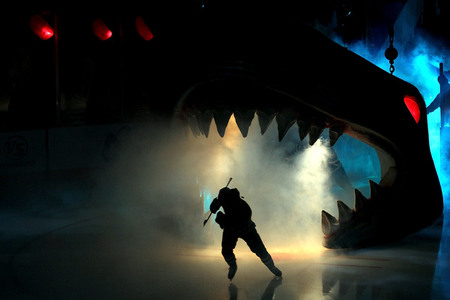
Welcome to the jung  wait, that's not it. Oh, that's right. This is the SHARK TANK! Also, WELCOME! (Caps lock on for emphasis because it's fun and I support the men in teal.) Not only is this a sweet silhouette photo op, the players literally enter the ice from the mouth of a foggy, red-eyed shark. It does not get any cooler than that. And you can try to find something to beat it, but one of two things will happen: you'll either die from fatal levels of awesome, or, the more likely outcome, you won't find jack. Unless you were looking for Jack. You might find him. He sounds cool, but not as cool as skating out of a demonic shark head. When they dim those lights, you best get to your feet; the Sharks are about to surface and feast on the unfortunate opponent.

Chomp chomp go the Sharks. And so do the fans. No, seriously. 
When San Jose is awarded a power play, nearly every single fan in the arena extends both arms forward, one claw hand on top of the other, palms facing each other, and moves the top hand to create a shark mouth ready to nosh on the competition. The Shark Chomp, accompanied with Jaws music, kicks so much ass. The music itself is cool, but throw in an arena full of chomping fans and it's unreal. Quite possibly the best display of fandom is the chomp. (I'm pretty sure this footage is super old, but the modern chomp looks exactly like this, just in high-definition.) Fan bases have their own unique in-game rituals. Sharks fans just happen to practice the premier, supreme, unsurpassed, unparalleled, ultimate, incomparable tradition. Shoutout to the thesaurus for all those synonyms of "best". One awkward adjective wasn't enough to describe the Shark Chomp. 


Sunday, October 19, 2014

Black and Gold 'till I'm dead and cold

Before I dive into my obsession over the new Penguins third jerseys, let me provide a small disclaimer. I support several NHL teams, including the Chicago Blackhawks, San Jose Sharks and New York Islanders. It's impossible for me to commit to one team like the "die hard" fans, who are obnoxious and often disrespectful to the sport and the players. And now I'm going off on a brief rant, so bear with me. All sports fans have the right to hate teams and players, but I'm bothered when they show blatant disrespect. If you hate a player, like Sidney Crosby, you should recognize his talent as well. Too often Crosby is referred to as a "pussy"(pardon my French) or other derogatory names. I would love to see fans jump into Crosby's skates and experience the game from his perspective. Fans, be obnoxious and crazy, just please show some respect for the elite hockey athletes who worked hard to get where they are today.

Now let's get back to our regularly scheduled blog post.


I'm currently pinching every penny I have so I can buy a gold Evgeni Malkin jersey.

Pittsburgh unveiled new third jerseys in September, which are a throwback their threads of the mid-1980's and early 1990's. The Penguins are my day one team, the first team I liked when I started to follow professional hockey, and these jerseys have rekindled my love. The yellow gold looks sharper than the bland, brown gold on the typical home and away jerseys.


The unveiling video is epic, though it could be better. I understand Crosby is the face of the Pittsburgh Penguins, but he lacks the intimidation factor. Quite frankly I'm more inclined to pinch his cheeks. Crosby will always be a cute little hockey player from Halifax, Nova Scotia, with naught a menacing bone in his body.

The Pittsburgh gold jerseys make their debut October 22 as the Penguins host their rivals from Philadelphia. The throwback sweaters will make an appearance 11 other times this season, but I say increase that number! Show off those gold threads. Make the hockey world remember a time when Pittsburgh dominated the ice, winning the 1991 and 1992 Stanley Cup. Make the sports world remember the "City of Champions" version of Pittsburgh, minus the Penguins, when the Steelers and Pirates won their respective championships. Pittsburgh gold pleases the eye more so than brown gold. Yuck.

One option the Penguins should consider is doing away with the brown gold jerseys and making gold the norm. Gold catches the eye; it's dazzling. Plus the blue jerseys make for great alternates when being so stylish grows old.


These beauties are a classic. Hockey jerseys remain the coolest of all sports uniforms, especially when there are laces at the neckline. It elicits memories of old-time hockey and playing on frozen ponds or lakes. Laces on jerseys create nostalgia. I think laces should be on every alternate jersey because it's a reminder of the sport's humble beginnings.

If the Penguins continue down the throwback path, it's not long before we'll return to the dark blue of the 1970's Penguins, before the struggling team switched to gold. And I cannot wait for that day.


How dope would Evgeni Malkin look in this bad boy? The answer is pretty dope. The logo hasn't changed much, but the colors sure have. Current away and home jerseys are nearly identical, save for coloring. I vote Pittsburgh throw it back even further to the dark blue in the very near future, like within the next five to seven years. Give me enough time to save money for yet another jersey for my collection, please. Several current NHL teams sport blue on their jerseys but nothing quite like what I'm now calling Pittsburgh blue.

Of course if the Pittsburgh blue is cursed, i.e. we revert to our losing ways of the '70s, maybe we should stick to variations of gold. I mean, we did win three Stanley Cups decked out in black and gold. It's probably best to save the blue for special occasions as alternate jerseys. Plus, blue doesn't fit well into the mantra "black and gold 'till I'm dead and cold."